20th June - St Fillan ("The Leper"), Abbot (6th cent)
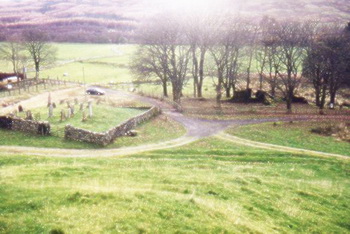
The graveyard and priory ruins
Fillan was a native of Ireland, and is also honoured there on this same day. He was said to have been filled with the desire for solitude in a strange country and with missionary zeal, so he travelled to Scotland and settled in the district known as Strathearn which extends from Loch Earn in Perth and Kinross to the River Tay. No particulars of his life are known.
Several remains speak of devotion shown to this holy man. The village of St Fillans, at the eastern end of Loch Earn, was dedicated to him, and from him took its name. His holy well is there still. In the vicinity there is a conical hill about 600 feet high, which is called Dunfillan. At the summit of the hill there is a rock which is known as St Fillan's Chair. From there it is said that St Fillan blessed the country around him.
The old ruined church at Aberdour, on the south coast of Fife, and the north shore of the Firth of Forth, looking south to the island of Inchcolm, was named after St Fillan. A holy well there, known as the Pilgrims' Well, was renowned as late as the eighteenth century for curing diseases of the eye. It is thought to have been dedicated to the patron of the church. A hospital of St Martha, for the benefit of pilgrims, was founded there in 1474, and was served by Sisters of the third Order of St Francis from 1487 up to the Reformation.
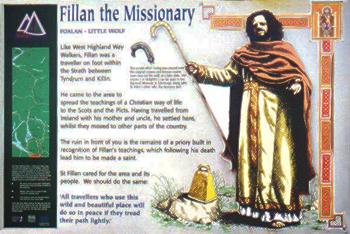
Today, on the West Highland Way, the 96 mile walking route running from Milngavie north of Glasgow to Fort William, St Fillan has a mention on a plaque in Strath Fillan as "a traveler on foot within the Strath between Tyndrum and Killin". It continues, "He came to the area to spread the teachings of a Christian way of life to the Scots and the Picts. Having traveled from Ireland with his mother and uncle, he settled here, whilst they moved to other parts of the country."
"The graveyard close by had many old stones in it - the oldest we could read recorded a man who died in 1752. To the right were the remains of what we assumed was the priory built in recognition of Fillan's teachings, which following his death led him to be made a saint. St Fillan cared for the area and its people. We should do the same. All travelers who use this wild and beautiful place will do so in peace if they tread their path lightly.″