
|
|
|
|
|
Sir Ninian Comper and Scotland | |

Sir Ninian Comper |
Sir John Ninian Comper (1864-1960) was a Scottish-born architect. He was one of the last of the great Gothic Revival architects, noted for his churches and their furnishings. He is also well known for his stained glass, his use of colour and his subtle integration of Classical and Gothic elements which he described as unity by inclusion. John Ninian Comper was born in Aberdeen on 10th June 1864, the eldest of the five children born to the Reverend John Comper, Rector of St John's Episcopal Church, and his wife, Ellen, daughter of John Taylor, Merchant of Hull. John Comper was born in 1823 at Pulborough, Sussex, and came to Scotland in 1848 to teach at the newly-founded church school at Kirriemuir. By the time John Comper came to teach at Kirriemuir he was already an adherent to the principles of the Oxford Movement, the high-church movement in the Church of England. In 1849 he moved to St Margaret's College, Crieff, and was soon pursuing studies in preparation for ordination in the Episcopal Church in Scotland. |
After completing his studies, Comper was ordained deacon in the Episcopal Church in 1850 by the saintly Bishop Alexander Penrose Forbes in St Ninian's Cathedral, Perth, the day after it was consecrated. The preacher at that service was the Revd John Mason Neale, the hymn-writer, with whom the young Comper kept up a warm friendship. Bishop Forbes was a close friend of one of the leaders of Oxford Movement, Edward Pusey, and was himself to suffer later at the hands of the Movement's enemies on the subject of Eucharistic Doctrine. Comper was ordained priest at Crieff in 1851 prior to his appointment at Nairn by Bishop Robert Eden to take charge of a new Mission to mitigate the effects of a schism caused by a group who had formed an "English" Episcopal Chapel. He was also put in charge of the newly created Mission at Cromarty before returning to the Brechin Diocese to fill the vacancy at Stonehaven in 1857 that originally met at the Stonehaven Tolbooth, where he remained until 1861 when he became incumbent of St John's Aberdeen. |
 The Revd John Comper |
He soon realised that the poorer quarters of the city of Aberdeen were hardly being reached by the Church, and he felt called to respond and resigned the charge at St John's in 1870 to spend more time in the mission he had founded in the Gallowgate slums of Aberdeen in 1867. He also founded St Margaret's Convent in The Spittal, bringing sisters up from Dr John Mason Neale's pioneering community at East Grinstead. In 1867 he established a mission church in the Gallowgate, one of the poorest slum areas of Aberdeen. He regarded this work as being so important that in 1870 he resigned from St John's to take up the less secure role of Mission Priest at StMargaret's, Gallowgate, and to devote his life and ministry to caring for the poor. John Comper was, by now, one of the leading priests of the Anglo-Catholic revival in the Episcopal Church. John Ninian Comper was born in Aberdeen and the lively and advanced Anglo-Catholicism amongst which the young Ninian was raised, naturally had a dominant influence on his life. In later years the 'Anglo-' came to mean less and less to him, and he would often appear not to recognise any difference between the Anglican and Roman Churches, maintaining that through the work of St Pius X, to whom he had a special devotion, the two communions were already, if secretly, united. After rather unhappy school-days at the Episcopal Church school, particularly for the sons of clergy in Glenalmond in Perthshire, Comper spent a year at Ruskin's Art School in Oxford, before going to London where he was articled to Charles Eamer Kempe, the Victorian stained glass designer and manufacturer, and later to George Frederick Bodley and Thomas Garner, partners and English Gothic Revival architects. Comper always Bodley regarded as his master, and like him always steadfastly opposed the system of qualifying examinations for architects and architectural schools: in "Who's Who" he described himself as "architect (not registered)". With the exception of the Welsh War Memorial in Cardiff (1928), all Comper's work was ecclesiastical. His first independent building was a chapel added to his father's church of St Margaret of Scotland, Aberdeen in 1889. The chapel, known today as "the Comper Aisle" was built in memory of Ninian's father, the Reverend John Comper. Thefigure of Fr John Comper, keeling at a prie-dieu, is shown in the magnificent east window in what today is know as the Comper Aisle. |
Ninian Comper's unique 'signature' can also be seen in this window. It's in its customary place at the bottom right of the window. His rather unusual signature of the strawberry is linked with his high regard for his father who demonstrated his evotion to the poor in so many practical ways. Fr John Comper died suddenly in the Duthie Park in Aberdeen, on the banks of the River Dee, while giving strawberries to poor children. What better memorial to his father ... the strawberry which can be seen in churches throughout the world! |
 |
The St Margaret's chapel was followed two years later by the new St Margaret's Convent Chapel in Aberdeen. This set the fashion, destined to become the norm for many successful Anglican convents ... a Comper chapel. One of his last works was the great window in Westminster Hall in London in 1952. In the course of seventy years Sir Ninian Comper was the architect responsible for fifteen churches; he restored and decorated scores of others; and he designed vestments, banners and windows in places as far apart as China, North America, France, India, and South Africa. There can hardly be a rural deanery in England or a Diocese in Scotland without some example of his sensitive and unmistakable workmanship which is also to be found in Roman Catholic churches, amongst them, Downside Abbey. |
|
 |
In 1892 St Margaret’s Convent Chapel was buily in Aberdeen, a fine Gothic chapel with canted, buttressed and castellated apsidal chancel with a white-washed interior with stencilled groin vaulting over apsidal chancel, and stencilled timber wagon roof. The priest's vestry had a Comper window depicting the Revd John Mason Neil, priest, scholar and hymnwriter who had formed the Sisterhood at East Grinstead and brought the Sisters to Aberdeen to support the work of the Revd John Comper. It is now in St Margaret's Church in the Gallowgate in Aberdeen. Between 1899-1907 the new church of St Margaret at Braemar in Deeside, was designed throughout by Ninian Comper, to replace the old church which had been badly damaged in a bad storm in 1893 - a fine example of Comper’s Gothic Revival design, with further additions: 1910, a carved wooden chancel screen, 1915, two memorial painted glass windows, 1921, a carved wooden Rood was added above the screen, and in 1928 a Comper-designed painted glass window was installed. |
St Mary’s, Kirriemuir, built in 1903 to replace a classical church of 1797 which had been destroyed by fire. The High quality furnishings are all by Comper including the altar, pulpit font and pews. All the stained glass windows are by Comper except one. One windows is a memorial to Comper’s father and another is dedicated to J M Barrie’s, the author of Peter Pan, was born in the town. St Magnus', Lerwick, has three Comper windows dating from 1904, honouring St John the Evangelist, the Blessed Virgin Mary and St Margaret of Scotland, which were originally in the nearby House of Charity but installed in the church in 1973. In 1930 the small church of St John the Baptist, Rothiemurchus by Aviemore, was designed by Comper, to replace a 'tin tabernacle, across the road, and built to a limited budget of no more that £2,850 which Comper achieved describing it as having "dignity coupled with the greatest simplicity" with a simple rose damask baldacchino above the altar and clear glass windows which, at Comper said do not interfere "with the glory of the surrounding trees". |
During the 1930s St Andrews Cathedral, Aberdeen, was enlarged and embellished by Ninian Comper to commemorate the 150th anniversary of the consecration in Aberdeen of Samuel Seabury in 1784 as the first Bishop of the Episcopal Church in the USA. The chancel has a large gold-painted baldachino and carved oak screen and the vaulted ceiling has decorative panels with the arms of the then 48 US states and local families. St Regulus, Cromarty on the Black Isle, contains fine stained glass windows by Sir Ninian Comper, and St Columba's, Nairn, has a rose window, in memory of Comper's father, who established both congregations and other churches with Comper windows include St John’s, Wick, St Michael and All Saints, Edinburgh, St James the Less, Penicuik, and All Saints, Lockerbie, while Holy Trinity, Pitlochry and St Drostan's, Old Deer in Aberdeenshire, each have a Comper Reredos. |
 |
 |
Comper's liturgical understanding of the purpose of a church was far in advance of any other architect of his time. It has been claimed that Ninian Comper was the greatest church furnisher since Wren. However, if he was primarily a decoratorrather than an architect, his decorative art was never simply for art's sake, but for the sake of the function for which he firmly believed a church exists, namely "as a roof over an altar". Comper built from the altar outwards, personally designing every detail of the furnishings, even down to the candle sticks, which had to fit in with his design. While bitterly opposed to 'modernism', he nevertheless anticipated by many years the changes that were to come: for example, his use of free-standing altars, of pure white interiors and strong clear colours, especially the typical Comper rose and green, and the combination of gilding, blue, and white. |
At St Wilfrid's Cantley in 1893 Comper erected an altar with riddel posts, the first of that succession of 'box-bed' altars whose use by inferior artists he came to deplore. In 1892 he installed a hanging pyx in St Matthew's Westminster (since removed), thus leading to a development in the practice of reservation in the Church. St Matthew's was the first of many examples of the hanging pyx of which the most elaborate was the nine-foot silver turris at All Saints' Margaret Street, and that in the Grosvenor Chapel. |
 |
Comper's first work in St Michael and All Angels, Inverness, was associated with the moving of the church from one side of the River Ness to the other. The church was founded in 1877 in the poorest area of Inverness, primary as a children's school by Canon Edward Medley who resigned from the Cathrdral to work in this deprived area of the town. His Mission soon became the Chapel of the Holy Spirit and with Bishop Robert Eden a simple church had been built. At the turn of the 1900s the area was becoming badly affected of the waters of the River Ness and the people were moved to the other side of the river. |
 |

|
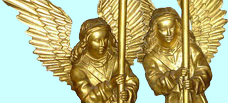
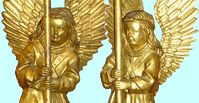
It was soon decided by the then Priest-in-Charge, the Revd William Lachlan Mackintosh, that the church must also move. During the work to move it stone by stone between 1903 and 1904, a full-sized stone altar was erected, around which were placed four black wrought iron riddel posts, topped by four gilded Angels, each holding a taper, designed by Ninian Comper. The new church was dedicated to St Michael and All Angels. One unique feature in the new church was created the following year, 1905, when an impressive stone font on top of a three step pedestal was placed by the west end of the church. The most spectacular feature is its very fine steepled oak lofty cover. |
|
It was also designed by Ninian Comper and given in memory of his father, the Revd John Comper, in thanksgiving for his ministry in Inverness. This is one of very few works by Comper carved in wood and a very special feature is Comper's famous signature - the strawberry, carved on one side in the wooden base of the steepled oak lofty cover. |

|
|
The finest example of Comper's first medieval style work is the church of St Cyprian in Clarence Gate in London (1903). His second style dated from about 1904 followed visits to the Mediterranean which revealed to him the debt owed by all Christian art to Greece. Other magnificent examples of his work are Wimborne St Giles, where in 1910 he restored a classical church with perpendicular decorations and distinctive Jacobean screen. Then there is the magnificent St Mary's Wellingborough (1904-40), where a perpendicular nave, middle-gothic side chapel, Spanish screens, and classical baldachino, combine brilliantly in one harmonious riot of colour and gilding. In his last period he grew more and more to see the importance of a free-standing altar, usually covered by a baldachin, a canopy over an altar, as in St Andrew's Cathedral Aberdeen, the All Saints' Chapel at London Colney (now owned by the Roman Catholic Church), at Pusey House in Oxford, or St Philip's Cosham, and by an uncumbered, translucent background to his windows. Between 1923 and 1924, St Michael and All Angels underwent extensive alterations. Canon Lachlan Mackintosh, Rector of St Michael's, had remained a good friend of Ninian Comper. Together they had been planning to completely rebuild St Michael's but financial constraints (the reconstruction was paid for entirely by the Canon himself), a result of the effects of the First World War, meant a re-construction rather than re-building should be considered. The work was done under the guidance of Ninian Comper. The old dormer windows were replaced by new lower, wider windows and the roof of the church was panelled and painted. The Lady Chapel was also extended. |
The magnificent stained glass Window of the Archangels above the altar with its Comper riddel posts and angels holding tapers on the east wall of St Michael's, and the Gilded Tester above, carved with a dove, both to designs by Ninian Comper, were later additions, in memory of Canon Mackintosh, St Michael's great benefactor, who died in 1926 and who is depicted keeling at a prie-dieu in the third window. The Archangels Uriel, Michael, Gabriel and Raphael (left to right)) are depicted in the window in the subtle colours favoured by Comper. The Gilded Tester above the High Altar depicts the Holy Spirit and Pentecost, with the tongues of fire radiating from the Dove, the Holy Spirit, with the seven 'Gifts of the Spirit' - Love, Joy, Peace, Patience, Kindness, Goodness and Faithfulness - inscribed around the border. |
 |
In 1890 Ninian Comper married Grace Bucknall. They had four sons, the eldest of whom followed in the steps of his father, and became an architect - and two daughters. His wife, Grace, died 1933. Sir Ninian Comper was knighted by King George VI in 1950 for his services to architecture, particularly in the design, restoration, and embellishment of churches and the design of ecclesiastical furnishings, stained glass and vestments. |
In 1907 the Dean of Westminster approached Comper to design a series of eight stained glass windows for the north side of the nave depicting figures of Kings associated with the Abbey together with an Abbot of Westminster from the same era and in 1932 Comper provided the furnishings for the Warriors Chapel in the nave (now St George's Chapel). Sir John Ninian Comper died on the 22nd December 1960 in The Hostel of God, now Trinity Hospice, in Clapham, London, a Hostel run by the Sisters of St Margaret from East Grinstead, the same Order that his father had brought to Aberdeen to share his work amongst the poor. It was very appropriate that the Sisters of St Margaret were there to care for Ninian at the close of his earthly. His ashes were buried beneath the windows he designed in the Abbey. The stone marking where Sir Ninian's ashes are buried was originally of slate but became very worn and it was replaced by a new granite stone cut by Sebastian Comper, Sir Ninian's son, with a Chi Rho cross at the top. |
 |
 |
Sir Ninian Comper's work in St Michael and All Angels makes clever use of the proportions of this small church, highlighted by the light which floods in through the large windows. The magnificence of the stained glass windows of the Four Archangels set behind Comper's riddel posted altar with its impressive gilded tester above, indeed make this a remarkable little church. Father Len Black was Rector of St Michael and All Angels and oversaw a quarter of a million pound major restoration in 2002. He was Rector for 31 years from 1980 until 2011 when he was ordained as a Catholic priest through the Personal Ordinariate of Our Lady of Walsingham, the third longest serving priest after William Lachlan Mackintosh (35 years), who was responsible for overseeing Sir Ninian Comper's work, and Reginald Errol Butchart (32 years). |
